


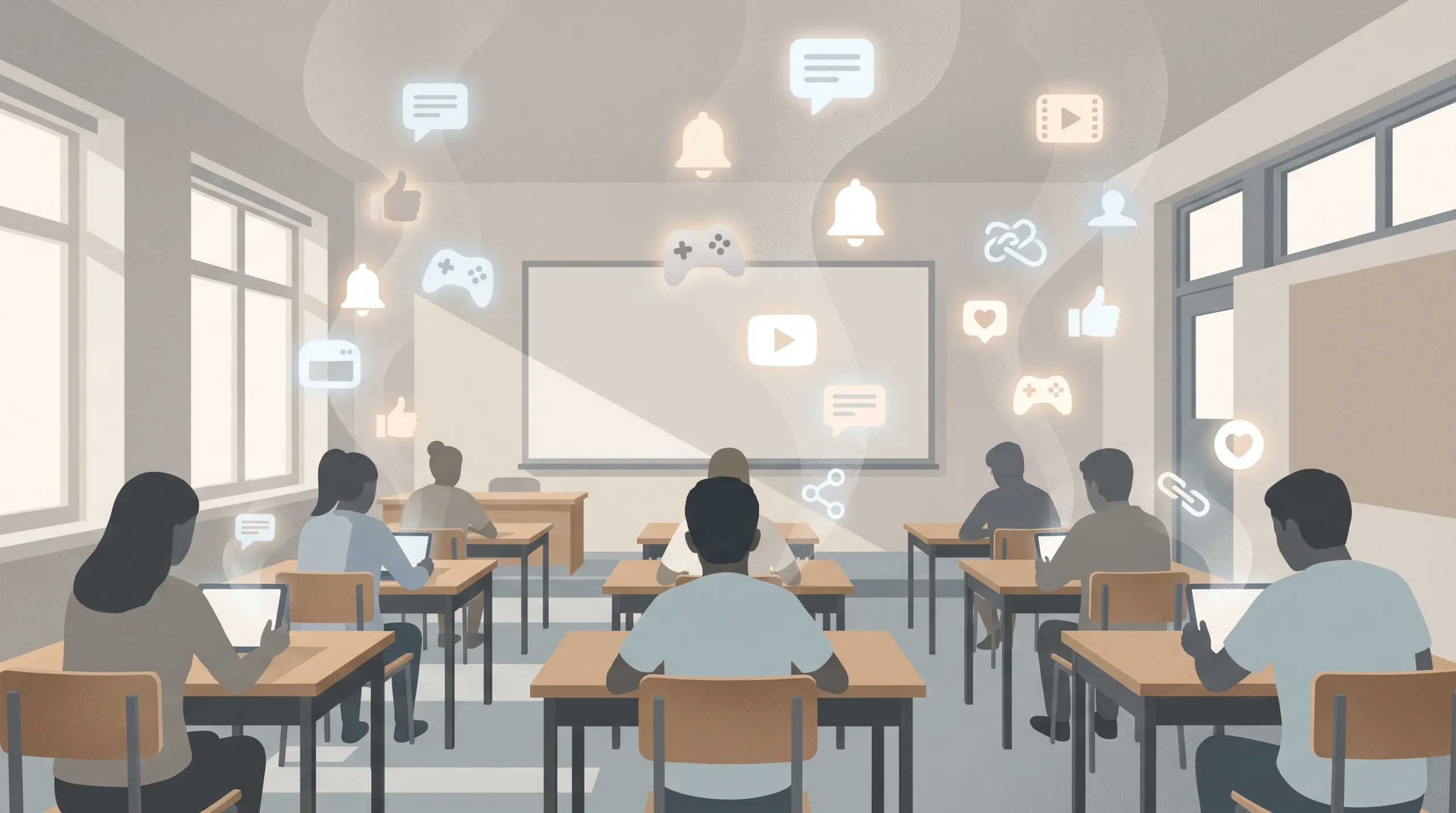
New findings from the 2025 Programme for International Student Assessment (PISA) have revealed that Australia faces some of the world’s most disruptive classroom environments. The report, released on Tuesday 8 September 2026, shows that more than 40% of Australian students struggle with noise and disorder, prompting senior politicians to call for a “digital detox” in schools.
Australia’s disciplinary climate is now ranked worse than 68 other participating nations. According to the data, 41% of students reported that their learning is frequently hindered by noisy and disorderly classrooms, a figure significantly higher than the average for members of the Organisation for Economic Co-operation and Development (OECD).
While Australia continues to perform “well above” the OECD average in science, reading, and maths, the latest results represent the country’s lowest-ever scores in maths and reading since the PISA cycle began in 2000.


Calls for a ‘digital detox’
In response to the data, Australian Education Minister Jason Clare suggested there is a “good argument our kids need a digital detox.” The debate over technology in the classroom has already led to significant policy changes at a state level.
Victoria has announced it will abolish “bring your own device” (BYOD) programmes in primary schools starting in January 2027. This move aligns with a growing movement in the country, supported by a 27,000-signature petition, calling for device-free primary education to reduce distractions.
The 2025 PISA study involved 760,000 students across 91 countries, focusing primarily on science for this cycle. The full OECD 2025 PISA report highlights a global trend of declining scores, though the severity of the disciplinary issues in Australia has set it apart from many of its economic peers.
The achievement gap
The data also highlights a widening inequality within the Australian education system. 15-year-old students in public schools are now the equivalent of two and a half years behind their peers in independent schools, according to analysis by the Australian Council for Educational Research (ACER).
In contrast to the declining trends in many Western nations, England’s performance showed resilience in the global rankings. According to the national report for England, the country has entered the international top 10 across all three core domains, ranking 8th in science, 9th in reading, and 10th in maths.
While England bucked the trend of falling scores, the global average for maths fell from 472 points in 2022 to 463 in 2025, with reading scores also dropping from 476 to 461. ACER, which manages the testing for the Australian government, confirmed that while the nation remains a high-performing system globally, the internal challenges regarding discipline and equity remain the primary concern for national policy.